
The worst thing you can do after picking a SaaS idea is open your code editor.
I know because I've done it. Multiple times. Pick an idea Monday morning. Start coding Monday afternoon. Two months later, ship a product nobody asked for. Spend another month trying to sell it. Get crickets. Move on to the next idea.
It took me five failed launches to figure out that the first 30 days after picking an idea should be spent on everything except building the product. The building part is the easiest step. Finding people who will pay for it is the hard part. And you should do the hard part first.
Here's the 30-day playbook I use now.
Day 1-3: Describe the customer, not the product
Before you write a single line of code, you need to answer one question: who exactly is going to pay for this?
Not "small business owners." Not "developers." Not "marketers." Specific people. Can you describe them in enough detail that you could find them on LinkedIn?
Here's an example. When I was evaluating the idea for a backlink submission tool, my initial target customer was "SaaS founders who need backlinks." Too vague. After talking to a few people, I narrowed it to "solo indie makers who just launched a product, have DR under 10, and are looking for a fast way to build domain authority without hiring an SEO agency."
That second description tells me exactly where to find them (indie hacker communities, r/SaaS, #buildinpublic on Twitter), what language they use (DR, backlinks, domain authority), and how much they'd pay (under $500, since they're bootstrapping).
Spend the first three days talking to potential customers. Not selling. Talking. Understand their problems. Ask what they've already tried. Ask how much they're spending on the current solution.
If you can't find 10 people who match your target customer description within three days, the market might be too small or too hard to reach.
Day 4-7: Build the landing page (not the product)
A landing page takes a day. A product takes months. Build the landing page first.
The landing page has one job: test whether your positioning resonates with real people. It needs:
A headline that describes the outcome. Not what the product does, but what the customer gets. "Build domain authority in 30 days, not 12 months" is better than "Automated backlink submission tool."
A subheadline that describes who it's for. "For SaaS founders who are tired of cold outreach and PBNs."
A price. This is controversial, but I always include a price on the landing page, even before the product exists. A waitlist signup from someone who's seen the price is worth 10x more than one from someone who hasn't. If they sign up knowing it costs $249, they're a real prospect.
An email capture or waitlist button. Simple. "Join the waitlist" or "Get early access." Nothing fancy.
I use Vercel for hosting and build these pages in Next.js because that's my stack. But a no-code tool like Carrd or Framer works just as well. The tool doesn't matter. The speed does.
Day 8-14: Drive traffic and measure interest
A landing page with zero traffic is a test that produces no data. You need people seeing it.
Reddit. Find 3-5 subreddits where your target customer hangs out. Don't post your landing page link. Post a genuinely helpful comment or thread about the problem your product solves. Include the link naturally in context. "I've been working on X" is fine. "BUY MY PRODUCT" will get you banned.
I've gotten more initial traction from Reddit than any other channel. The key is being genuinely helpful. Answer questions. Share your experience. Be a community member, not a spammer.
Twitter/X. If you have even a small following, tweet about the problem you're solving. Not the product. The problem. "I spent 400 emails trying to get 3 backlinks. There has to be a better way." That kind of post generates conversations, and conversations generate landing page visits.
Google Ads (small budget). $50-100 targeting the exact keywords your customer would search. If "how to get backlinks for SaaS" has search volume, run a small ad and see if the clicks convert to signups. This tells you whether the intent is there.
Metrics to track:
- Page views to signup rate (above 5% is good, above 10% is great)
- Total signups after one week
- Where signups came from
If after a week of promotion you have zero signups, that's a signal. Maybe the positioning is wrong. Maybe the price is wrong. Maybe the audience isn't where you think they are. Adjust and try again before building anything.
Day 15-21: Pre-sell or go concierge
This is the step most founders skip, and it's the most important one.
You have signups. People are interested. Now prove they'll pay.
Option 1: Pre-sell. Email your waitlist and offer early access at a discount. "The product launches in two weeks. Early access is $149 instead of $249. Full refund if you're not satisfied." If people pay, you've validated demand with actual money.
Option 2: Concierge. Do the thing manually for 5-10 people. If your product automates backlink submissions, submit the backlinks yourself for a few customers. Charge them for it. Even a small amount ($50, $100) proves willingness to pay.
When I was validating one of my idea databases, I manually curated 500 ideas and sold access for $29. People bought it. That told me the demand was real before I built the full database engine.
The goal of this week isn't revenue. It's proof. Proof that someone, somewhere, will open their wallet for what you're building. If you can't get a single person to pay during this phase, building the full product is a risky bet.
Day 22-28: Build the MVP (finally)
Now, and only now, do you build.
The MVP should do one thing well. Not five things adequately. One thing that solves the core problem you validated in weeks 1-3.
Here's what I mean by "one thing":
For a backlink tool, the MVP is: submit site details, get listed on 12 directories. That's it. No dashboard, no analytics, no automated tracking. Just the core value.
For an idea database, the MVP is: browse ideas, filter by category. No AI generation, no validator, no community features. Just the database.
For a portfolio platform, the MVP is: create a profile, add projects, get a public URL. No revenue tracking, no leaderboard, no themes. Just the basic page.
Build in a framework you already know. Don't learn a new stack for your MVP. Speed matters more than architecture at this stage.
I use tools like BuildTheIdea to accelerate this phase. The toolkit includes 89 detailed business ideas with MVP feature lists, tech stack recommendations, and business models already mapped out. When you're building your first product, having a reference for "what does a good MVP scope look like" saves you from the most common mistake: building too much.
Day 29-30: Launch and start learning
Launch means: real people can use it and pay for it. Not "launch on Product Hunt" (save that for later). Just... make it available.
Email your waitlist. Post in the communities where you found traction during the landing page phase. Tell people it's ready.
Then listen. The first week after launch teaches you more than the previous month of building. Real users will tell you what's broken, what's missing, and what they actually care about (which is almost never what you think they care about).
Track two numbers:
- Conversion rate: What percentage of visitors sign up or buy?
- Retention: Do they come back? Do they use it more than once?
If conversion is low, your positioning or pricing is wrong. If retention is low, the product isn't solving the problem well enough. Both are fixable. Neither requires starting over.
What most founders get wrong about this process
They build first, validate later. This is the classic mistake. Two months of coding, then "time to find customers." By then, you've built something nobody asked for and you're emotionally attached to a product that might not have a market.
They skip the pricing test. Signups without pricing are meaningless. I've had landing pages with hundreds of signups that converted to zero sales when I added a price. The price test is the real test.
They mistake interest for demand. "That's a cool idea!" is not the same as "I'll pay $50/month for that." Friends, family, and Twitter followers will tell you your idea is great. Strangers with credit cards are the only validation that matters.
They over-scope the MVP. If your MVP takes more than a month to build, it's not an MVP. Cut features until it makes you uncomfortable. Then cut one more.
They underinvest in distribution. The best product in the world fails if nobody finds it. Spend at least as much time on distribution (landing page, communities, ads, content) as you spend on building.
Growth channels that actually work for micro-SaaS
After launching multiple products, here's where I've found the best results:
SEO (long-term). Write content targeting keywords your customers search for. This compounds over time but takes months to produce results. Start early, but don't rely on it for initial traction.
Reddit (medium-term). Be genuinely helpful in communities where your customers hang out. This takes consistent effort but produces warm leads.
Twitter/X (short-term). Building in public generates awareness fast if you have an audience. If you don't, it's slower but still worth doing. Every post about your building process is a potential customer touchpoint.
Product Hunt / Uneed (spike). Great for a launch-day spike of traffic and signups. But the traffic is temporary. Plan for what happens after the spike.
Backlinks and domain authority. This is the unsexy but effective long game. Get your product listed on relevant directories with dofollow backlinks. Build domain authority so your content ranks. This compounds indefinitely.
I have a database of 50+ Reddit communities and 35+ backlink platforms inside BuildTheIdea specifically for this purpose. When founders ask me "where do I find my first users?", the answer is almost always "the communities where your target customers already hang out."
The 30-day recap
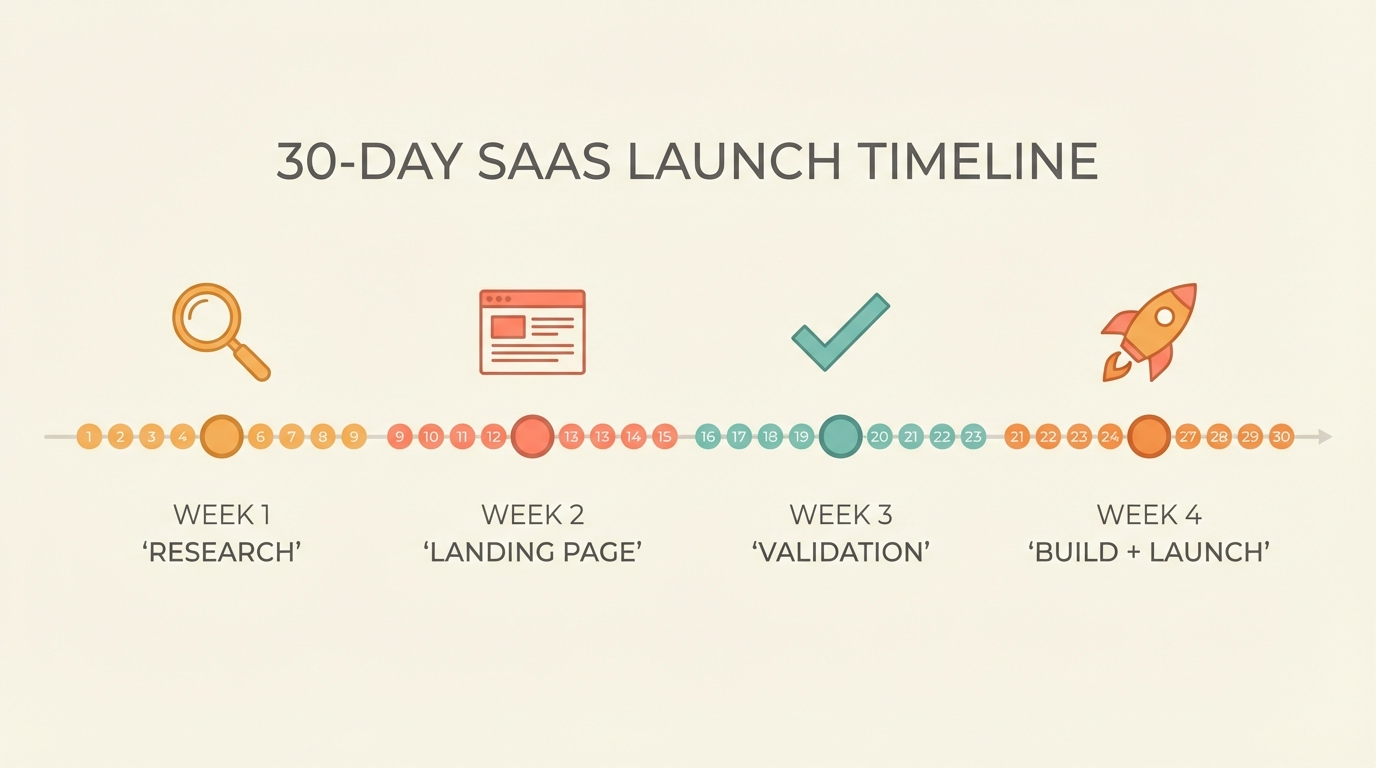
| Week | Focus | Output |
|---|---|---|
| 1 | Customer research | Target customer description, 10 conversations |
| 2 | Landing page + traffic | Live page, 50+ visits, signup rate data |
| 3 | Validation | Pre-sales or concierge customers |
| 4 | Build + launch | Working MVP, first real users |
This isn't a guaranteed formula. Some products take longer. Some validation experiments fail and you need to pivot or pick a new idea. That's fine. The point is to fail fast and cheap rather than slow and expensive.
A failed landing page test costs you one week. A failed product you built for three months costs you a quarter of the year.
After day 30
The first 30 days get you from idea to launched product. Everything after that is a different game: retention, growth, feature development, and the long grind of finding product-market fit.
But the foundation you build in the first 30 days determines whether you have something to grow or something to abandon. If you validated properly, you're building with confidence. If you skipped validation and went straight to code, you're building with hope. Hope is not a strategy.
Pick the idea. Describe the customer. Build the page. Test the price. Then build the product.
That order. Every time.
I'm building in public as a solo founder running 14+ web properties. Follow me on X/Twitter for daily updates on what's working, what's failing, and what I'm learning along the way.